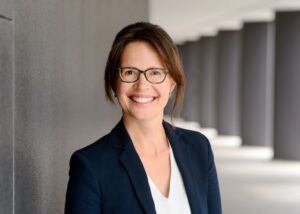
Prof. Dr.-Ing. Annelies Vandersickel from DLR and University of Stuttgart is to IEA Energy Storage Task 44 what “a whip” is to a political party: She makes sure that the task partners deliver and the task progresses according to the plan.
By Julie Søgaard
IEA Energy Storage Task 44 recently held its 4th Expert Meeting at Technical University of Denmark (DTU). DaCES is a partner in Task 44 together with a range of our members.
While the host and venue change every meeting the operating manager remain the same: Deutsches Zentrum für Luft- und Raumfahrt e. V. (DLR) – German Aerospace Center.
“Together with the subtask leads DLR defines the task and coordinates all the expert meetings. We also coordinate several meetings in between those meetings. Here, we try to support the subtask leads in their work and align their work with the overall goals of the task and with the different subtasks,” Prof. Dr.-Ing. Annelies Vandersickel says.
Makes sure there is progress in the task
Annelies Vandersickel is the Head of Department, Thermal Process Technology, at DLR and Professor of Thermal Energy Storage at the University of Stuttgart.
Her colleague at DLR, Scientific Officer Kevin Ludwig, is responsible for most of the organizational work of Task 44, while Annelies Vandersickel has another role.
“My main task is to keep the big picture in mind, but also a tangible output like pushing for papers or pushing for policy briefs and connect our task with the overarching IEA bodies,” Annelies Vandersickel says.
In short her task is to make sure there is progress in Task 44 and so far, it looks good.
“There’s definitely progress. It is always challenging to advance these tasks because it’s task sharing, which means there is no or little additional funding for the specific activities in the task. Everybody is working on it voluntarily,” Annelies Vandersickel says.
But she noticed it helps working towards concrete outputs, like a policy brief or a review paper, because they are relevant both for the task and partners.
“So, we try to align personal goals and existing project goals with the goals of the task to make sure it advances,” Annelies Vandersickel says.
She thinks Task 44 is a great platform to support existing collaborations between the task partners and to create new research projects.
“It is also a way to get a better insight into the business side of these technologies and understanding where the bottlenecks are,” Annelies Vandersickel says.
Additionally, she believes the task increases focus on thermal energy storage and Carnot batteries, which have been overlooked compared to other storage technologies such as batteries and hydrogen.
“Together, we have a strong voice to emphasize that power to heat and storage can really decarbonize heating and provide the necessary flexibility,” she says.
From engine combustion to thermal energy storage
Annelies Vandersickel was originally a mechanical engineer. She studied in Belgium and did her PhD in combustion engineering in Switzerland at ETH in Zurich.
“I was modeling the combustion inside of an engine. But after having spent four years in this field I realized that talking about cars, which always was the topic at the end of a conference, was not really my cup of tea. So, I moved to the domain of energy systems modeling at MIT, where I looked into integrating different components of a chemical plants with the energy supply system,” she says.
Here, she encountered thermal energy storage systems and moved to the Technical University in Munich, where she headed a group on thermal energy storage and energy system modeling for eight years.
Today, she works at DLR in the energy branch of the German Aerospace Center.
“I am in the institute of Technical Thermodynamics, where we develop all kinds of energy storage systems. My department focuses on the thermal part. We develop power to heat solutions and thermal energy storage for both district and industrial applications – either industrial sites, chemical sites or power plants,” Annelies Vandersickel says.
The department work on component development up to a functioning prototype on a relevant scale and drives demonstration in collaboration with industrial partners.
Next step in Task 44
The next Expert Meeting is in spring 2026 in Graz. In the meantime the focus will be on bringing all the collected data and information together in a matchmaking matrix – a framework set up by Silvia Trevisan from KTH, who was interviewed earlier this year.
“We have collected a lot of information on the different technologies that are available and on different types of use cases, where Carnot batteries and storage supported power-to-heat can be implemented,” Annelies Vandersickel says and continues:
“Our core task until the next meeting is to get a first draft of this matchmaking matrix filled with all of the information, we got from the different participants, so we can discuss it and refine it in the next meeting.”