
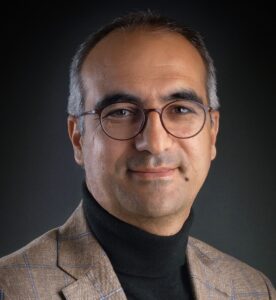
Batteries can improve energy security and resilience. And to accelerate innovation and get funding for new battery applications, we need stronger collaboration between solution providers, technology developers, and end users, Associate Professor at AAU Energy, Amin Hajizadeh, says.
By Julie Søgaard
When participating in Battery Innovation Days in Stockholm this week Associate Professor at AAU Energy, Amin Hajizadeh, will present some of the frontrunning battery projects he is working on, in a session with focus on innovation in stationary battery applications.
“One is a Horizon Europe project (BLUEBARGE) with several European partners on how we can use mobile batteries for electrification in the ports and maritime sectors,” Amin Hajizadeh says.
In the BLUEBARGE project, two battery technologies are integrated into a large power barge that serves as a mobile energy storage and supply unit. The barge can be deployed close to ports or offshore locations to provide electrical power and charging services to vessels, cruise ships, and other ships that either lack sufficient grid access or cannot connect directly to the local electricity network.
From EV batteries to grid support
Another application project (ReSTOREBESS) in collaboration with the company Gridturn is based on national funding from EUDP.
“Here, we want to make a modular battery from EV batteries. But there are several challenges around of that because we use different cells, different battery modules from different cars, and then we make a battery module,” Amin says and continues:
“So first we must know what is the state of charge? What is the health of these batteries, and how much energy can they provide if they are connected to the grid?”
The idea is to use these batteries as backup during the peak demand and to contribute to balancing and flexibility market.
Building a more resilient energy system
In Stockholm Amin Hajizadeh would like to discuss different aspects of batteries. He points out that batteries, specifically stationary batteries, can improve energy security and resilience in a time of increased electrification.
“If something happened in the main grid, if we had an outage in the grid, then batteries, especially stationary batteries, can give support in this situation, improve the resilience and provide more security to the energy in the society,” he says.
And in order to develop more and better battery applications, Amin Hajizadeh believes stronger collaboration is needed across the whole value chain. Such collaboration is essential to develop battery systems that not only store energy but also provide flexibility and ancillary services that help grid operators maintain a stable, reliable, and resilient power system.
“Future battery systems will play a key role in energy security, grid flexibility, and resilience. To develop these solutions and bring them to market, Denmark needs stronger partnerships between academia, industry, technology providers, end users, and grid operators,” Amin Hajizadeh concludes.